
Seven fires. Three months. More than fifty lives. A hospital ICU. A family hotel. A residential building at 3 AM. The systems that could have changed every single one of these outcomes exist, are widely available, and cost less than a month's electricity bill. They simply were not there.
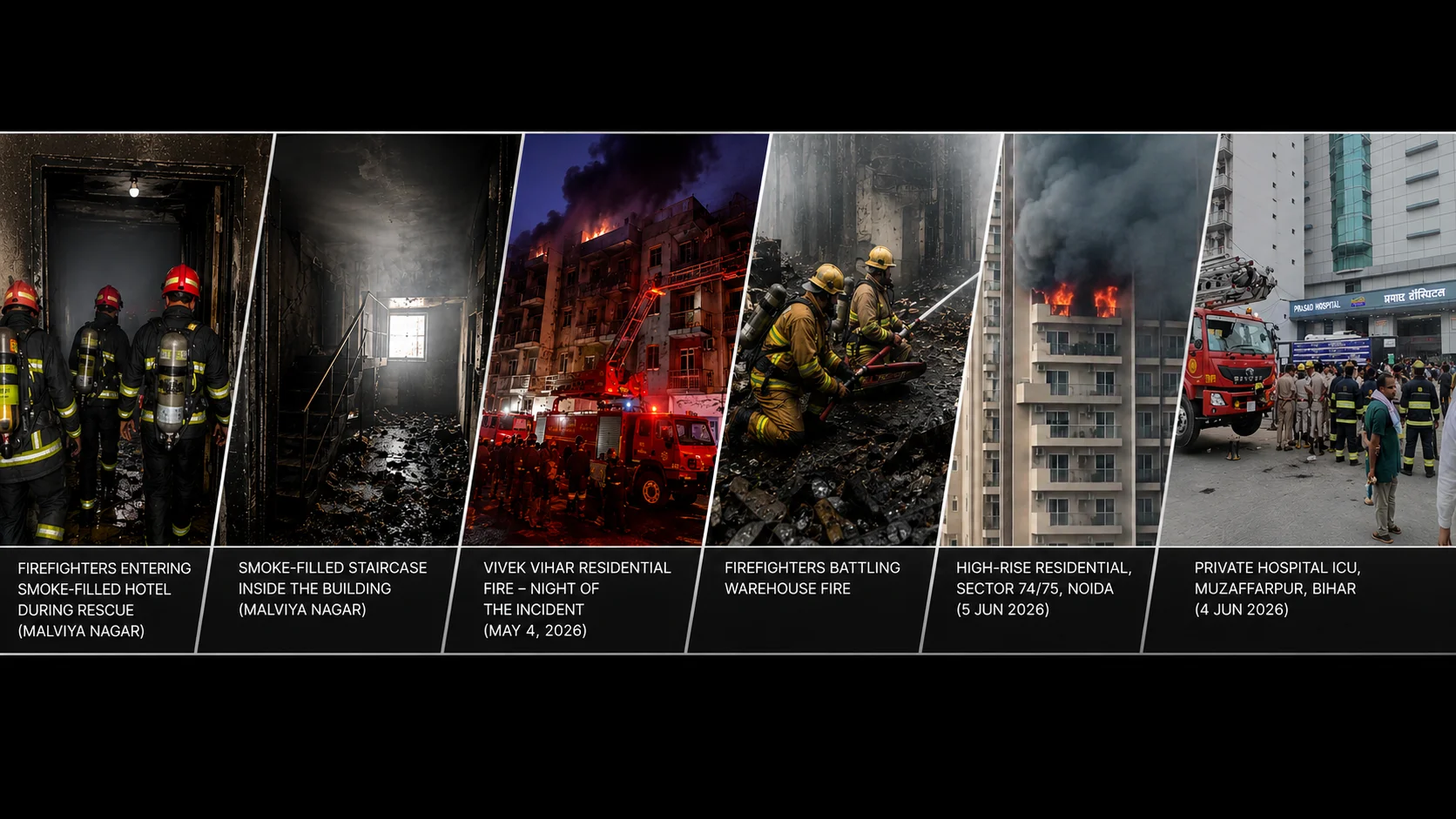
This is not a story about fires. It is a story about a choice — made quietly, repeatedly, by building owners, hotel operators, and business associations — to treat fire safety as someone else's problem. That choice has a body count. In the last three months, it crossed fifty.
Every building fire on this list started the way most fires start — a short circuit, an overloaded AC unit, a spark near flammable material. Ordinary ignition. What converted each into a mass casualty event was the same in every case: nobody was watching, and nothing was set up to raise the alarm.
The systems to change that outcome are not experimental or expensive. A basic smoke detector costs under ₹2,000. A professionally monitored fire detection system for a mid-sized hotel costs a fraction of a month's room revenue. These are not luxury upgrades. They are the minimum responsible infrastructure for any building where human beings sleep, work, or receive medical care. Across all seven incidents — a hospital ICU, a B&B full of foreign nationals, a four-storey home at 3 AM — not one had any of it.
The Seven Incidents — March to June 2026
Causes shown are preliminary or under investigation per official statements at time of publication. Sources: PTI, ANI, The Week, Hindustan Times, Tribune India, India TV News, Business Standard, Deccan Herald, DFS, NHRC.
| Date / Location | Building Type | Dead | Cause (Preliminary) | The Lapse That Mattered |
|---|---|---|---|---|
| 4 Jun 2026 Muzaffarpur, Bihar |
Private Hospital ICU Prasad Hospital, 5th floor, 3:55 AM |
3–5 | Suspected short circuit | ICU patients on ventilators — unable to self-evacuate. Smoke filled the unit before staff could act. No detection of any kind. |
| 5 Jun 2026 Sector 74/75, Noida |
High-Rise Residential IVY County, 28-storey, ~8 AM |
0 | Under investigation | Fire on floor 12 — 16 floors of residents above the origin. Zero casualties because it was daytime. The same scenario at 3 AM has a very different outcome. |
| 3 Jun 2026 Malviya Nagar, S. Delhi |
B&B Hotel Flourish Stay — near Max Hospital Saket |
21 | Under investigation — No Fire NOC | Licensed for 6 rooms — operating 25–26 including illegal basement. Single exit. Sealed windows. 17 of 21 dead were foreign nationals. First detection: a neighbour on the street saw smoke. |
| 28 May 2026 Hauz Khas, S. Delhi |
Private Residence South Delhi bungalow, 11:10 PM |
1 | AC indoor unit blast | Dhanendra Kumar, 80 — first CCI chairman — died of smoke inhalation. A well-maintained South Delhi home. No monitoring. If it can happen here, "my building is safe" has no basis. |
| 16 May 2026 Shahberi, Gr. Noida |
Furniture Market Dense commercial cluster, ~10 PM |
0₹lakhs lost | Suspected short circuit in plastic goods shop | Fire spread "extremely quickly" through furniture and flammable stock. 30+ tenders deployed. Green corridor required — narrow roads blocked access. 8 shops gutted. Zero detection in any shop. Fire went from ignition to fully involved before a single alert was raised. |
| 3 May 2026 Vivek Vihar, E. Delhi |
Residential Building (4-storey) 3:48 AM — occupants asleep |
9 | Suspected AC fault or short circuit | Electronic smart locks jammed. Resident called 112 — told it wasn't their jurisdiction. Technology was installed for comfort. Nothing was installed for safety. |
| 18 Mar 2026 Palam, SW Delhi |
Residential Above Shops | 9 | Suspected short circuit | Three children and a 70-year-old woman among the dead. Most died of smoke inhalation — fire below, smoke rising silently while the family slept. NHRC issued notices. |
* Bihar hospital death count: DM confirmed 3; Municipal Commissioner stated 5. † 2% Fire NOC figure: Tribune India, citing Delhi Fire Services data.
"I called 112 at 3:50 AM. They said it wasn't their jurisdiction — gave me three numbers, all not functioning. The fire department came after 15 minutes. By then we were putting mattresses down for people to jump onto."
— Resident survivor, Vivek Vihar, to The Week, May 3, 2026
01 — Awareness: Most People Don't Know What a Monitored System Actually Is
Ask the owner of a mid-sized hotel whether their building has fire safety. They will point to a red extinguisher on the corridor wall. That extinguisher is a tool — not a system. It does not detect. It does not alert. It does not know a fire has started.
A smoke detector is different. It detects before there is visible flame — often 60 to 120 seconds ahead of when a person would notice. That window is where outcomes are determined. In Palam, a family slept above a ground-floor fault. In Rohini, a couple and their two-year-old were asleep at 1:25 AM near open plastic scrap. In Muzaffarpur, ICU patients were on ventilators. In every case, those 90 seconds were the difference between an evacuation and a recovery operation.
02 — Importance: When People Know, They Still Underestimate
The most common response from building owners who are aware fire detection systems exist is: "We haven't had a fire yet." The seven incidents above dismantle that logic. The Hauz Khas fire was a private residence in one of Delhi's most established neighbourhoods — a retired senior IAS officer, a well-maintained home, an AC unit that had probably worked without incident for years. The Vivek Vihar building was a normal four-storey residential structure. IVY County is a gated society with a security gate and maintenance staff.
None of this conferred protection. The fire did not care about the neighbourhood's reputation. What determined the outcome was whether anyone had installed a system that could detect the fire before the smoke reached the people inside. The Vivek Vihar building had electronic smart locks — technology installed for comfort, with nothing installed for safety. That is precisely backwards. The monitoring layer should always precede the convenience layer.
03 — Willingness: The Systems Exist. Choosing Not to Use Them Is an Active Decision.
The Malviya Nagar B&B owner did not fail to obtain a Fire NOC because he was unaware it was required. He admitted during police questioning that the building lacked the mandatory certificate. He knew. He chose not to obtain it. He chose to operate 25 rooms where 6 were permitted. He chose to seal the windows and lock the basement exit. Each was not an oversight — it was a decision. And twenty-one people paid for it.
The willingness problem extends beyond individual owners. Building associations, resident welfare organisations, and market trade bodies are in a position to set collective standards — and largely have not. A market association for Shahberi could mandate smoke detection for every member shop. A housing society could make monitored fire safety part of its maintenance standard. A hotel association could make it a membership requirement. None of these require new laws. They require only the willingness to hold each other accountable.
04 — Enforcement: Rules Exist. They Are Simply Not Applied.
India is not without fire safety rules. The National Building Code mandates fire safety measures for buildings above certain heights. The Model Building Bye-Laws require fire NOCs. Most states have fire services acts with inspection provisions. The legal architecture is extensive. What is largely absent is follow-through.
The Fire NOC is in practice a one-time certificate. It does not require continuous monitoring. It does not expire if a building doubles its room count or constructs an illegal basement. A building can obtain a NOC, then quietly double its capacity and lock its exits — and nobody will know until a fire starts.
Hotel and accommodation operators: A monitored smoke detection system fulfils the intent of the NOC requirement even where formal compliance is lagging. It is also the only system that actually does what the NOC is meant to ensure — someone responds when a fire starts, not twenty minutes after the fire department arrives.
Housing society committees: Mandate smoke detectors in common areas and stairwells as part of the annual maintenance levy. A monitored system for an entire tower, divided across residents, is smaller than most monthly maintenance charges. IVY County — zero casualties, full evacuation — is what best-case looks like without monitoring. It will not always be best-case.
Hospital management boards: The Muzaffarpur ICU fire is unambiguous. Patients on ventilators cannot self-evacuate. A hospital ICU without monitored fire detection is not a medical facility — it is a liability. The investment required is measurably smaller than the legal, financial, and human cost of June 4, 2026.
The Window That Is Always There
Every one of these fires had a gap — minutes between ignition and unsurvivable. In every case, that window was not used because no system was watching it. The Vivek Vihar resident called 112 two minutes after the fire started. Was told it wasn't their jurisdiction. Fire arrived 15 minutes later. The difference between 2 minutes and 15 is not a system failure. It is an absence of system.
Three children in Palam. A two-year-old in Rohini. A retired public servant gone from smoke inhalation in his own home. Twenty-one people who crossed oceans for medical care, killed in the building that was meant to be their safe place. ICU patients who had no ability to help themselves, in a unit with no system to help them.
After each fire: condolences, compensation, an inquiry. Before each fire: no alarm. No monitoring. No one watching.
The systems that could have changed these outcomes are on the shelf. Affordable. Available. Proven. The only thing standing between where we are and where we need to be is the decision — by every building owner, association, and board — to stop treating fire safety as someone else's responsibility. The people inside your building are counting on you to have made that decision before the smoke starts rising.
A Camera That Records Is Not Security.
A System That Watches Is.
Intelitor builds active monitoring infrastructure for buildings where people sleep, work, and recover. AI-assisted detection combined with 24×7 human verification and a 2-minute response protocol. Not a certificate on a wall. A system that knows — and acts — before the smoke reaches the stairwell.
For hotel operators, housing societies, hospitals, commercial facilities — the question of who is watching at 3 AM should have a clear answer. It should be us.
Related topics